

Nucleic acid-based therapeutics have emerged as one of the fastest-growing classes of innovative medicines, offering new treatment opportunities for diseases that have traditionally been difficult to address using conventional small molecules or biologics. Antisense oligonucleotides (ASOs), small interfering RNAs (siRNAs), aptamers, messenger RNA (mRNA) therapeutics and other nucleic acid-based modalities are rapidly progressing through drug development, driving the need for robust bioanalytical methods capable of accurately characterizing these complex molecules (1,2).
Compared with traditional small molecules, oligonucleotide therapeutics present unique analytical challenges. Their relatively large molecular size, high polarity and susceptibility to nuclease-mediated degradation complicate extraction and quantification from biological matrices. In addition, they often generate truncated metabolites that may differ from the parent compound by only a single nucleotide while exhibiting distinct pharmacological or toxicological properties. Consequently, sensitive and selective bioanalytical methods are essential to support pharmacokinetic, toxicokinetic, biodistribution and biomarker studies (1–3).
At Kymos, we support the bioanalysis of nucleic acid therapeutics using molecular biology and mass spectrometry-based methodologies, developing fit-for-purpose analytical methods for both preclinical and clinical studies.
Bioanalytical approaches for nucleic acid therapeutics
The analytical strategy depends on both the therapeutic modality and the objectives of each study. Since no single technology can answer every analytical question, complementary analytical techniques are often combined to address different bioanalytical endpoints. At Kymos, these approaches include:
- Quantification of biomarkers using highly sensitive real-time quantitative PCR (qPCR), with detection down to 1 pg/mL.
- Quantification of therapeutic oligonucleotides using hybridization ELISA, qPCR and LC-MS/MS.
- Quantification of DNA, mRNA, siRNA, aptamers and antagomiRs.
- Gene expression analysis using the ΔΔCt method.
- Detection of viral and bacterial DNA or RNA.
- Biodistribution studies for DNA- and RNA-based therapeutics and vaccines.
- Residual human DNA analysis to evaluate allograft decellularization efficiency.
While qPCR remains the method of choice for many biomarker and gene expression applications, the increasing complexity of therapeutic oligonucleotides has driven the adoption of complementary analytical technologies that provide greater molecular specificity and metabolite characterization.
LC-MS/MS: expanding the analytical toolbox
Recent advances in liquid chromatography coupled with tandem mass spectrometry (LC-MS/MS) have significantly expanded the analytical toolbox available for therapeutic oligonucleotides (2–4). Unlike hybridization ELISA assays, LC-MS/MS directly identifies analytes according to their molecular mass and characteristic fragmentation patterns, allowing accurate quantification of the parent compound together with discrimination of closely related metabolites. In contrast to hybridization-based methods, LC-MS/MS provides direct molecular detection, enabling not only accurate quantification but also structural confirmation of the analyte. This additional level of specificity is particularly valuable when analyzing chemically modified oligonucleotides or distinguishing closely related metabolites that may not be differentiated using probe-based assays alone.
This capability is particularly valuable because therapeutic oligonucleotides frequently undergo exonuclease-mediated degradation, producing shortened metabolites such as N−1 species that may contribute to efficacy or safety. LC-MS/MS is also well suited for chemically modified oligonucleotides, including phosphorothioate oligonucleotides and ligand-conjugated molecules, providing high analytical specificity and confidence in analyte identification (1–4).
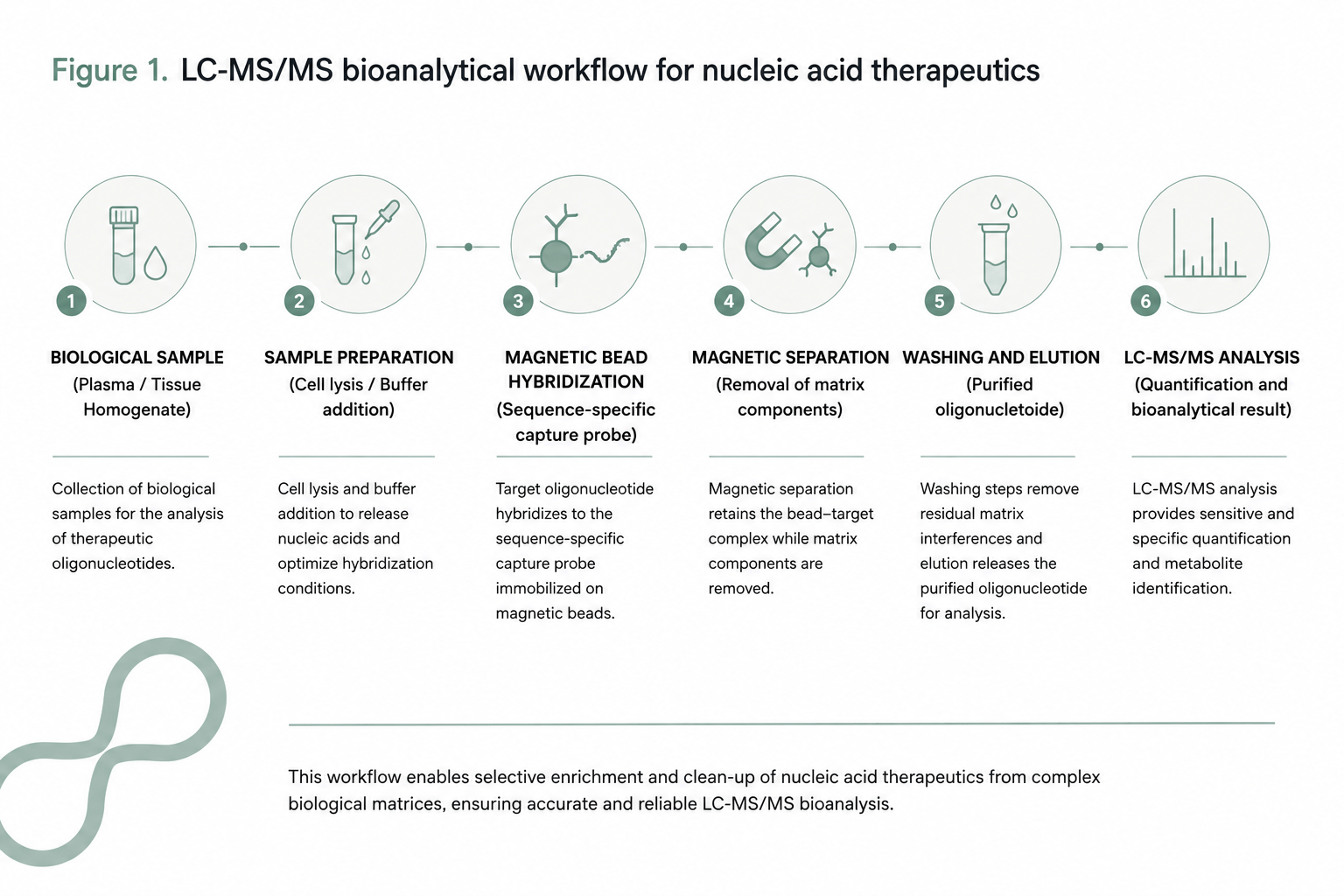
LC-MS/MS methods at Kymos support the analysis of therapeutic oligonucleotides in plasma and tissue homogenates. Sequence-specific magnetic bead hybridization enables selective sample purification before quantitative LC-MS/MS analysis across concentration ranges typically between 1 and 1000 ng/mL.
Magnetic bead hybridization: the key to selective sample preparation
Efficient sample preparation is critical for successful LC-MS/MS bioanalysis. Biological matrices contain proteins, phospholipids and endogenous nucleic acids that can interfere with mass spectrometric detection. To overcome these challenges, Kymos employs sequence-specific magnetic bead hybridization before LC-MS/MS analysis (1,2).
Magnetic particles are functionalized with capture oligonucleotide probes that are complementary to the therapeutic sequence of interest. The capture probes are immobilized on the magnetic bead surface, typically through biotin-streptavidin interactions, ensuring stable and highly selective binding throughout the extraction process. Following hybridization, a magnetic separator isolates the bead-target complexes while the remaining biological matrix is removed. Proteins, phospholipids and other endogenous matrix components are efficiently eliminated during subsequent washing steps, and controlled elution releases the purified oligonucleotide for LC-MS/MS analysis.
This workflow is rapid, highly selective and compatible with automated liquid-handling platforms, making it suitable for high-throughput studies. Compared with conventional extraction methods, magnetic bead hybridization offers several advantages:
- High sequence specificity.
- Efficient purification from complex biological matrices.
- Reduced matrix effects and ion suppression.
- Excellent reproducibility and low sample carry-over.
- Compatibility with automated high-throughput workflows.
- Accurate discrimination of closely related metabolites, including N−1 degradation products (1,2,4).
By combining selective enrichment with highly specific LC-MS/MS detection, this integrated workflow enables robust quantification of therapeutic oligonucleotides in challenging biological matrices, supporting pharmacokinetic, biodistribution and metabolism studies.
Supporting the next generation of nucleic acid therapeutics
Nucleic acid-based medicines continue evolving, and bioanalytical methodologies must also advance to address their growing complexity. Rather than replacing established techniques such as qPCR or hybridization ELISA, LC-MS/MS complements these approaches by providing enhanced molecular specificity and metabolite discrimination (2–4).
Combining molecular biology expertise with advanced mass spectrometry capabilities, Kymos delivers bioanalytical solutions adapted to each therapeutic modality and study. Integrating complementary analytical techniques enables a more complete characterization of therapeutic oligonucleotides, supporting pharmacokinetic, biodistribution and metabolism studies while providing the reliable data required to accelerate the development of the next generation of nucleic acid-based medicines.
References
- Rooney M, Ji QC, Leung K, et al. Hybridization Liquid Chromatography-Tandem Mass Spectrometry: An Alternative Bioanalytical Method for Antisense Oligonucleotide Quantitation in Plasma and Tissue Samples. Analytical Chemistry. 2020;92(15):10239-10247.
- Yuan L. Hybridization Liquid Chromatography-Mass Spectrometry for Quantitative Bioanalysis of Oligonucleotides: The Upcoming Paradigm Shift. Journal of Chromatography A. 2026;1766:466575.
- Yuan L. Bioanalysis of Oligonucleotides. In: Ahuja S, Dong MW, editors. Specification of Drug Substances and Products: Development and Validation of Analytical Methods. Elsevier; 2025. p. 209-243.
- Gilar M, Biba M, DeLano M, et al. Bioanalysis of Oligonucleotide by LC-MS: Effects of Ion Pairing Reagents and Recent Advances in Ion-Pairing-Free Analytical Strategies. Molecules. 2022;27(23):8875.
- European Medicines Agency. Guideline on Bioanalytical Method Validation. EMA; 2011.
- Resolve Mass Spectrometry. LC-MS Bioanalysis for Oligonucleotides. Available at: https://resolvemass.ca/lc-ms-bioanalysis-for-oligonucleotides/ (accessed July 2026).