

Orally Inhaled and Nasal Drug Products (OINDPs) are one of the most complex pharmaceutical dosage forms to develop. Their performance depends not only on the formulation itself but also on the delivery device, manufacturing process and the ability to consistently deliver the intended dose to the patient.
Recognizing this complexity, the European Medicines Agency (EMA) has revised two complementary guidelines covering the pharmaceutical quality (Guideline on the pharmaceutical quality of inhalation and nasal medicinal products) and therapeutic equivalence (Guideline on the requirements for demonstrating therapeutic equivalence between orally inhaled products (OIP) for asthma and chronic obstructive pulmonary disease) of inhalation and nasal medicinal products. Together, these documents synthesize current scientific knowledge, advances in inhalation technologies and the regulatory framework for drug-device combination products.
Although many of the underlying scientific principles are not changing, the newly revised guidance places more emphasis on product understanding, analytical characterization and the generation of robust in vitro data throughout development. For pharmaceutical companies, this represents an opportunity to strengthen development strategies while aligning analytical programs with current regulatory expectations.
Looking beyond regulatory compliance
The revised OINDPs quality guideline does more than update technical requirements. It reinforces a broader approach to product development, where formulation, delivery device, manufacturing process and patient use are considered together rather than as independent elements.
This integrated perspective covers the entire product lifecycle: it goes from pharmaceutical development and batch characterization to commercial manufacturing and post-approval changes. Developers are encouraged to build a comprehensive understanding of how different variables influence product performance and to generate analytical evidence that supports product consistency over time.
For inhalation medicinal products, this includes demonstrating that critical quality attributes (CQAs) remain consistent throughout development. Parameters such as aerodynamic particle size distribution (APSD), delivered dose and device performance directly influence where the drug is deposited in the respiratory tract and, ultimately, its clinical performance. Likewise, nasal medicinal products require detailed characterization of formulation and device attributes to ensure consistent delivery to the intended site of action.
Analytical characterization plays an increasingly important role
A common theme in both guidelines is the growing importance of analytical data in supporting product quality and regulatory decision-making.
Rather than relying only on final product specifications, developers are expected to generate a robust understanding of the product throughout its development. This includes characterizing both the formulation and the delivery device, evaluating product performance under representative conditions and demonstrating manufacturing consistency (as seen in Figure 1 below).
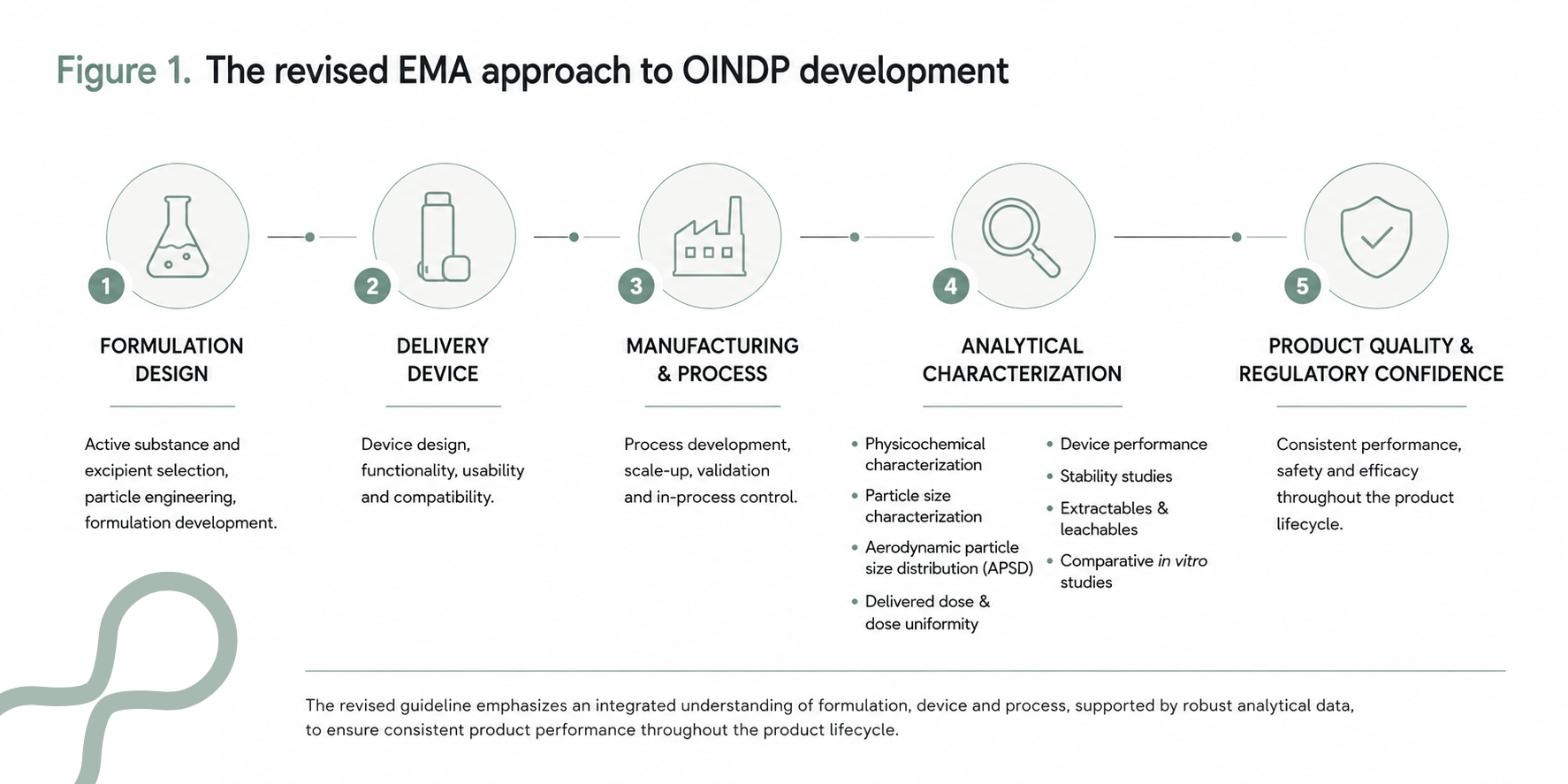
Depending on the product and development stage, the analytical package may include studies such as:
- Physicochemical characterization
- Particle size characterization
- Aerodynamic Particle Size Distribution (APSD)
- Delivered dose and dose uniformity
- Device performance evaluation
- Stability studies
- Extractables and Leachables (E&L) studies
- Comparative in vitro performance studies
Many of these studies are already well established in OINDP development. The revised guideline, however, places greater emphasis on their role in building scientific understanding of the product and supporting regulatory submissions throughout its lifecycle.
Therapeutic equivalence starts with in vitro evidence
The revised guideline on therapeutic equivalence complements the pharmaceutical quality guidance by describing a stepwise approach for demonstrating equivalence between orally inhaled products.
The process begins with comprehensive in vitro comparisons. When these data are sufficient to demonstrate therapeutic equivalence, additional studies may not be necessary. If in vitro evidence alone is insufficient, pharmacokinetic studies become the preferred next step, while comparative clinical endpoint studies are generally reserved for situations where previous levels of evidence cannot adequately demonstrate equivalence (as seen in Figure 2 below).
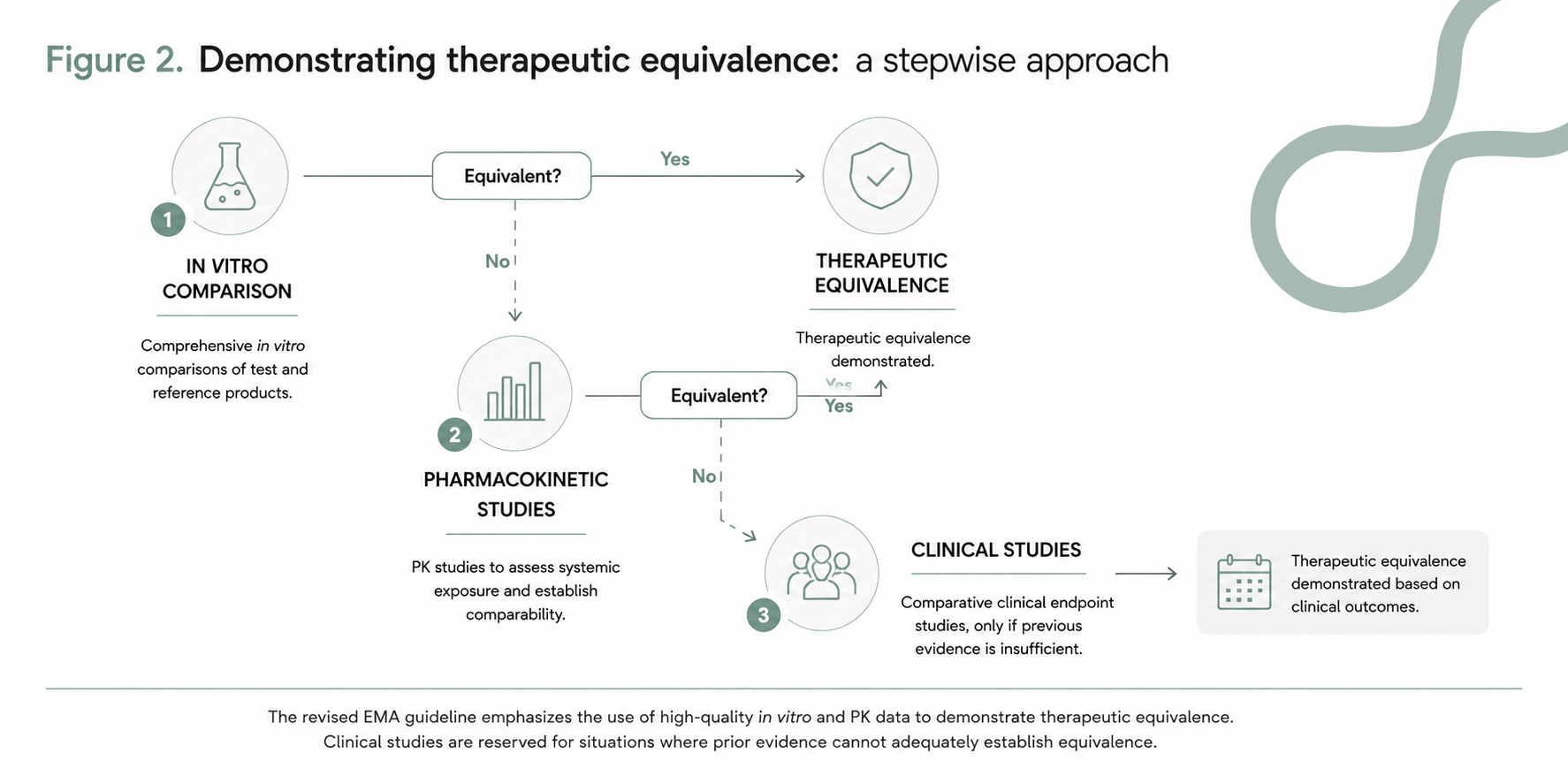
This approach is aligned with the increasing value regulators place on high-quality analytical and in vitro data. Generating robust comparative evidence early in development can help support regulatory strategies, reduce development costs and time, and facilitate interactions with health authorities and regulatory bodies.
Building analytical strategies for today’s regulatory landscape
Taken together, the revised EMA guidelines encourage developers to move past a compliance-driven approach and adopt a more comprehensive understanding of product quality.
Rather than considering analytical testing as a final checkpoint before submission, developers are increasingly integrating analytical characterization throughout pharmaceutical development. This allows critical quality attributes to be monitored from early formulation work through process optimization, scale-up, technology transfer and lifecycle management.
The result is not simply better regulatory documentation, but greater confidence that the product will consistently perform as intended throughout its commercial life. Adopting this workflow not only ensures regulatory compliance, but it also reduces development costs and accelerates time-to-market, the main goal of every pharmaceutical developer and manufacturer.
Supporting OINDP development with analytical expertise
Developing inhalation and nasal medicinal products requires analytical methods capable of characterizing complex formulations, evaluating device performance and generating reliable data to support regulatory submissions.
At Kymos Group, we support pharmaceutical companies throughout the development of OINDPs with analytical services covering pharmaceutical development, quality control and regulatory support. Our capabilities include physicochemical characterization, particle characterization, in vitro performance testing, extractables and leachables studies, stability testing, analytical method development and validation, as well as GMP quality control testing and batch release.
Regulatory expectations continue to increase, and comprehensive analytical characterization is becoming an increasingly important part of successful OINDP development. Working with experienced analytical partners can help developers generate the scientific evidence needed to support product quality while navigating an increasingly demanding regulatory environment.
Are your analytical strategies aligned with the latest EMA expectations for OINDPs? Our experts can help you design analytical programs that support development, regulatory submissions and lifecycle management for inhalation and nasal medicinal products. Get in touch with our team today to discuss your OINDP project.